


Choosing whether to hire a WordPress development agency vs freelancers is no longer a simple budget decision.
In 2026, WordPress websites are expected to function as full-scale digital platforms, supporting performance optimization, security hardening, SEO, integrations, and long-term scalability.
What once worked as a quick freelance engagement can now become a bottleneck for growth if the development model doesn’t match the project’s complexity.
This decision matters even more for businesses planning redesigns, migrations, or custom WordPress builds.
Modern WordPress development services often involve enterprise-level requirements such as Core Web Vitals optimization, advanced security controls, third-party integrations, and ongoing maintenance.
A misaligned choice between a freelancer and a WordPress agency can lead to delays, technical debt, or recurring rebuild costs.
In this guide, I’ll break down the real differences between a WordPress agency vs freelancer, explain when each option makes sense, and provide a practical framework to help you choose the right development model based on your goals, not just short-term cost.
Table of contents
- Core Differences: WordPress Development Agency vs Freelancer
- When to Hire a Freelancer for WordPress Projects ?
- Signals You Should Hire a Freelancer
- When to Hire a WordPress Development Agency ?
- WordPress Development Agency vs Freelancers: Decision Framework
- WordPress Development Agency vs Freelancers: Risk Factors and Mitigation
- Cost and Value Realities in 2026
- Why Growing Teams Choose a WordPress Development Agency (like WPBrigade )
- How to Evaluate Potential WordPress Development Partners
- Frequently Asked Questions
- Hire WordPress Development Agency vs Freelancers: Conclusion
Core Differences: WordPress Development Agency vs Freelancer
Understanding the structural differences between a WordPress development agency vs freelancer helps clarify why each option performs differently as projects scale.
While both can deliver functional WordPress sites, the way work is executed, managed, and maintained varies significantly.

A. WordPress Agency vs Freelancer: Skillset and Team Structure
A WordPress development agency operates with a cross-functional team. This typically includes:
- WordPress developers
- UI/UX designers
- QA testers
- SEO and performance specialists
- Project managers
This structure allows agencies to handle custom WordPress development, complex integrations, and enterprise-level requirements without relying on a single individual’s availability or expertise.
Freelancers, on the other hand, usually offer deep expertise in a specific area—such as front-end development, custom plugin work, or theme customization.
This focus works well for narrowly defined tasks but can become limiting when a project requires multiple disciplines or parallel execution.
Key difference:
Agencies offer breadth and redundancy; freelancers offer specialization and independence.
B. Project Management and Communication Models
WordPress agencies follow structured project workflows. These often include:
- Defined scopes and milestones
- Dedicated project managers
- Documented communication and reporting
- Formal QA and deployment processes
This approach reduces delivery risk on long-term or multi-phase projects, especially where multiple stakeholders are involved.
Freelancers typically work through direct communication with the client.
This can feel faster and more flexible, particularly for short engagements. However, the lack of formal project management can lead to:
- Scope creep
- Inconsistent timelines
- Dependency on one person’s availability
Key difference:
Agencies prioritize process and predictability; freelancers prioritize speed and flexibility.
C. Cost Structure and Transparency
From a cost perspective, freelancers generally appear more affordable due to:
- Lower hourly or project rates
- No agency overhead
However, freelance pricing often covers only execution, not long-term accountability, QA, or maintenance.
WordPress development agencies charge higher upfront fees, but these typically include:
- Planning and documentation
- Quality assurance
- Security and performance considerations
- Post-launch support or maintenance options
Key difference:
Freelancers optimize for short-term cost savings; agencies optimize for lifecycle value and stability.
When to Hire a Freelancer for WordPress Projects?
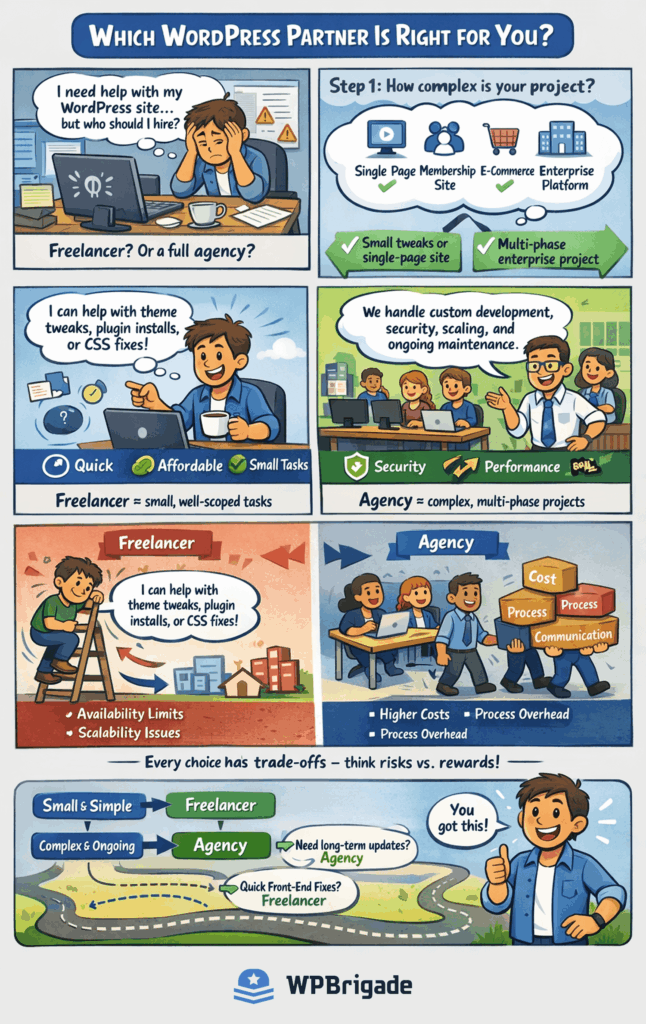
Hiring a freelancer makes sense when your WordPress project is clearly scoped, time-bound, and limited in complexity.
Freelancers are often the right choice when speed and cost efficiency matter more than long-term scalability or process depth.

Best Fit Scenarios for Freelancers
Freelancers are well-suited for:
- Single-page or brochure-style websites
- Minor theme customizations
- Plugin installation and configuration
- Content layout or formatting updates
These tasks typically don’t require cross-functional coordination or extended QA cycles.
Tight Budgets and Short Timelines
If you’re working with:
- Limited budgets
- Urgent turnaround requirements
A freelancer can often start quickly and deliver faster due to fewer dependencies and approval layers.
This is especially useful for short-term campaigns or temporary site updates.
One-Off or Specialized Tasks
Freelancers excel at niche, task-specific work, such as:
- CSS or UI tweaks
- Writing custom code snippets
- Debugging a specific WordPress issue
- Conducting a focused SEO or performance audit
In these cases, hiring a specialist can be more efficient than onboarding a full team.
Signals You Should Hire a Freelancer
A freelancer is likely the right fit if:
- The project scope is fully defined and unlikely to change
- Integration requirements are minimal
- There is no expectation of ongoing WordPress maintenance
- You have internal resources to manage deployment and future updates
For businesses needing quick execution without long-term commitment, freelancers offer flexibility and cost control, provided the project remains contained.
When to Hire a WordPress Development Agency?
Hiring a WordPress development agency is the better choice when your project extends beyond a one-time build and requires strategic planning, scalability, and long-term support.
Agencies are designed to handle complexity, coordination, and growth-focused WordPress development.
Best Fit Scenarios for a WordPress Development Agency
A WordPress agency is ideal for projects involving:
- Membership or subscription platforms
- eCommerce stores with custom workflows
- Advanced third-party integrations (CRMs, ERPs, marketing tools)
- Custom plugins or bespoke themes
These projects require custom WordPress development across multiple stages, where planning, testing, and documentation are just as important as execution.
Long-Term Support and Maintenance Requirements
If your site requires:
- Ongoing security updates
- Performance monitoring and optimization
- Traffic scaling and uptime management
- Regular feature enhancements
This reduces operational risk and prevents technical debt from accumulating over time.
A WordPress development agency provides structured WordPress maintenance services, ensuring continuity beyond launch.
Enterprise WordPress Development Needs
Enterprise WordPress development demands:
- High availability and performance reliability
- Compliance and security best practices
- SEO and Core Web Vitals optimization
- Coordination across design, development, and marketing teams
Agencies are equipped to deliver these outcomes through cross-functional teams and established workflows, making them better suited for business-critical WordPress platforms.
Signals You Need a WordPress Development Agency
You should strongly consider an agency if:
- Future growth and feature expansion are anticipated
- Ongoing updates and performance monitoring are required
- Multiple disciplines (design, development, SEO, QA) must work in parallel
- Downtime, security issues, or delays would directly impact revenue
In these situations, a WordPress agency offers predictability, accountability, and scalability, which become essential as WordPress projects move from simple websites to growth platforms.
WordPress Development Agency vs Freelancers: Decision Framework
If you’re still weighing whether to hire a WordPress development agency vs freelancers, this checklist helps map your project requirements to the right engagement model.
Rather than focusing on cost alone, use this framework to evaluate risk, scalability, and long-term value.
| Decision Category | Freelancer | WordPress Development Agency |
| Project Complexity | Low to medium complexity | Medium to high complexity |
| Budget Model | Cost-sensitive, short-term | Strategic investment |
| Timeline | Fast turnaround, flexible | Structured delivery with milestones |
| Scope Creep Risk | Higher due to the limited process | Lower with defined workflows |
| Long-Term Support | Optional or uncertain | Built-in or contract-based |
| Need for Diverse Skills | Rare or task-specific | Frequent and cross-functional |
| Scalability Requirements | Limited | Designed for growth |
| Accountability | Individual-based | Team and SLA-driven |
This framework highlights a key pattern:
Freelancers work best when requirements are stable and limited, while agencies perform better when projects evolve over time and require ongoing collaboration.
For businesses planning sustained growth, predictable delivery, and long-term maintenance often outweigh short-term cost savings.
Agencies like WPBrigade offer built-in, long-term WordPress maintenance, providing ongoing updates, performance monitoring, and security oversight, benefits that freelancers typically cannot match.
WordPress Development Agency vs Freelancers: Risk Factors and Mitigation
Every WordPress engagement carries risk. The key difference between working with a freelancer or a WordPress development agency lies in how those risks are distributed and managed.
Understanding these trade-offs helps avoid costly disruptions later.
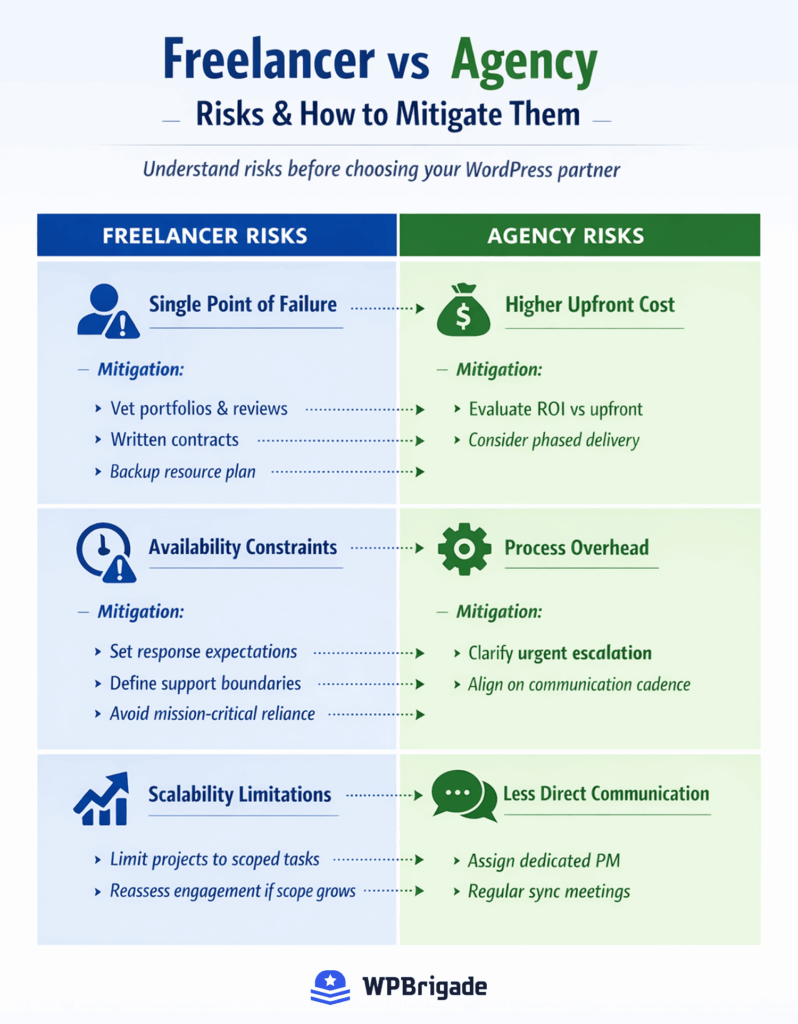
A. Risks When Hiring Freelancers
Below are some risk factors you should be aware of before choosing freelancers vs WordPress agency.
Single Point of Failure
Most freelancers operate independently. If they become unavailable due to illness, workload, or shifting priorities, your project may stall or stop entirely.
Mitigation:
- Vet portfolios and client reviews carefully
- Use written contracts with clear deliverables and timelines
- Maintain documentation and access credentials internally
- Have a backup freelancer or internal resource identified
Availability Constraints
Freelancers often juggle multiple clients, which can impact response times during urgent issues or post-launch support.
Mitigation:
- Set response-time expectations upfront
- Define support boundaries in the contract
- Avoid relying on freelancers for mission-critical uptime needs
Scalability Limitations
As requirements grow, a single freelancer may struggle to manage increased scope, integrations, or performance demands.
Mitigation:
- Keep freelance work limited to well-scoped tasks
- Reassess engagement as soon as complexity increases
B. Risks When Hiring a WordPress Development Agency
Higher Upfront Costs
Agencies typically require a larger initial investment compared to freelancers, which can be challenging for smaller teams.
Mitigation:
- Evaluate cost against long-term ROI
- Choose phased delivery instead of large one-time builds
Process Overhead
Structured workflows can feel slower for simple or urgent tasks.
Mitigation:
- Clarify escalation paths for urgent fixes
- Align on communication cadence and approval flows
Less Direct Day-to-Day Communication
Working through project managers can reduce direct developer access.
Mitigation:
- Request a dedicated point of contact
- Establish regular syncs and transparent reporting
By proactively addressing these risks, businesses can align their WordPress development services with their operational needs rather than react to issues after launch.
Cost and Value Realities in 2026
In 2026, the cost of WordPress development is less about hourly rates and more about outcomes, reliability, and long-term value.
Comparing a WordPress agency vs freelancer purely on price often overlooks hidden operational costs that surface after launch.
Freelancer Cost Models
Freelancers typically charge:
- Hourly rates
- Fixed pricing for clearly defined tasks
While this model appears cost-effective upfront, it often excludes:
- Quality assurance and testing
- Documentation and handover
- Ongoing WordPress maintenance
- Accountability for long-term performance
As the project scope expands, additional revisions, fixes, or support requests can increase total spend unpredictably.
WordPress Agency Pricing Models
WordPress development agencies usually offer:
- Project-based pricing for builds and migrations
- Monthly retainers for maintenance and optimization
- Ongoing partnerships for continuous development
These models account for:
- Planning and architecture decisions
- Security and performance best practices
- Cross-functional collaboration
- Post-launch monitoring and support
The result is greater cost predictability for long-term projects.
Understanding True ROI
Return on investment from WordPress development is increasingly tied to:
- Site uptime and performance stability
- Security resilience
- Scalability under traffic growth
- Reduced rework and technical debt
While freelancers may reduce initial spend, agencies often deliver higher ROI over time by preventing issues that disrupt growth or revenue.
Why Growing Teams Choose a WordPress Development Agency (like WPBrigade)
For businesses that outgrow ad-hoc development and one-off fixes, choosing the right WordPress agency becomes a strategic decision.
A long-term partner should offer more than code delivery; it should provide stability, scalability, and accountability across the entire WordPress lifecycle.
A reliable WordPress partner acts like a custom wordpress development company.
WPBrigade works as a full-service WordPress development agency, supporting teams that need consistent execution without relying on fragmented freelance workflows.
Comprehensive WordPress Development Services
WPBrigade delivers end-to-end WordPress development services, including:
- Custom WordPress theme and plugin development
- Performance and Core Web Vitals optimization
- Security hardening and best-practice implementation
- Integrations with marketing, analytics, and third-party platforms
This unified approach helps reduce handoff delays and ensures technical decisions support long-term growth.
Built for Scalability and Enterprise WordPress Development
As WordPress platforms scale, so do their operational demands. WPBrigade supports enterprise WordPress development needs such as:
- High-availability infrastructure planning
- Traffic and performance scaling
- SEO-aligned development workflows
- Multi-environment deployment and testing
Rather than reacting to growth, WPBrigade helps teams plan for it from the start.
Ongoing WordPress Maintenance & Accountability
Unlike short-term freelance engagements, WPBrigade provides structured WordPress maintenance agency support, including:
- Regular updates and security monitoring
- Performance audits and optimizations
- Proactive issue detection
- Clear SLAs and communication processes
This ensures continuity, even as team members or requirements change.
Process Transparency and Team-Based Delivery
WPBrigade operates with:
- Documented workflows
- Dedicated points of contact
- Cross-functional teams instead of single dependencies
For growing teams, this translates into predictable delivery, reduced risk, and measurable progress, without the uncertainty that often accompanies freelance-only models.
How to Evaluate Potential WordPress Development Partners
Selecting the right WordPress partner requires more than comparing rates. Use these criteria to objectively assess freelancers or agencies and ensure alignment with your project’s goals.
1. Portfolio Review
- Examine previous projects to assess quality, complexity, and design standards.
- Look for relevant experience in your industry or with similar project types.
- Check if the developer or agency has handled enterprise-level integrations or multi-phase builds.
2. Testimonials and Case Studies
- Client reviews highlight real-world performance, reliability, and communication.
- Case studies demonstrate problem-solving, technical depth, and long-term results.
- Look for metrics-driven results (e.g., performance improvements, reduced downtime, conversion impact).
3. Communication Process
- Confirm the preferred channels, frequency, and point of contact.
- Ensure expectations around reporting, milestone reviews, and approvals are clear.
- A predictable communication cadence reduces misunderstandings and project delays.
4. Support and Warranty Terms
- Understand what post-launch support is included.
- Determine response times for critical issues or downtime.
- Clarify warranty coverage for custom plugins, themes, or integrations.
5. Pricing Clarity
- Compare pricing models: hourly, project-based, retainers.
- Identify any hidden costs, such as plugin licenses, server setups, or additional revisions.
- Ensure pricing aligns with expected outcomes and project complexity.
Frequently Asked Questions
Can you show relevant project experience?
How do you handle post-launch support?
Who will be my point of contact?
What processes ensure on-time delivery?
How do you manage security, updates, and performance optimization?
Hire WordPress Development Agency vs Freelancers: Conclusion
Choosing whether to hire a WordPress development agency vs freelancers depends on your project’s complexity, timeline, and long-term growth goals.
Freelancers are ideal for small, well-defined tasks or short-term updates, offering speed and cost efficiency.
Agencies, on the other hand, provide scalability, cross-functional expertise, and structured processes, making them the better choice for multi-phase projects, enterprise-level builds, and ongoing WordPress maintenance.
By understanding the core differences, risk factors, and cost/value trade-offs, decision-makers can select the partner that aligns with both current needs and future growth.
Structured evaluation, through portfolios, case studies, and clear communication expectations, ensures a smooth engagement and predictable results.
When considering your next WordPress project, ask yourself:
“Do I need quick execution, or am I investing in a partner who will scale and support my website long-term?”
Further Readings:
We’d love to hear from you: Which challenges have you faced when choosing between freelancers and agencies for WordPress projects, and what influenced your decision? Share your experience in the comments below!