
Can your business survive the digital race without embracing low code no code development?
Today, more than 75% of new enterprise applications are built with visual tools for low code and no code development.
The global technology sector faces a shortage of developers and a strong demand for faster delivery.
In the past, building a web application required a team of specialized engineers and developers.
However, the emergence of the Citizen Developer, enabled by AI-assisted tools and visual logic, has made launching products quickly a key advantage for both startups and large companies.
Governance has become a major challenge, making sure that apps built by non-technical teams are secure, scalable, and well-integrated is now a top priority.
At WPBrigade, we believe the future of development is not just about choosing between coding and visual tools.
Instead, it’s about using a hybrid approach that blends the speed of low-code solutions with the structure of professional development.
In this guide, I’ll examine how lasting this shift is and share strategies to help you leverage it for long-term success in your digital projects.
Table of contents
- What is Low Code No Code Development?
- Why Businesses are Shifting to Low-Code No-Code Development
- Low-Code vs No-Code vs Full Custom Development
- Low-Code in the WordPress Ecosystem
- From No-Code Setup to Scalable Systems
- Limitations of Low-Code/No-Code
- Why Low Code No Code is the Future of Digital Projects
- FAQs on Low Code No Code Development
- Conclusion : Low-Code Website Solutions
What is Low Code No Code Development?
Low-code/no-code development is a visual approach to software creation that abstracts complex programming into intuitive, graphical interfaces.
So instead of writing thousands of lines of syntax from scratch, users interact with logic blocks, drag-and-drop components, and AI-guided scaffolding.
Low-Code: The Developer’s Turbo-Charger
Low-code is designed for hybrid teams that mix professional developers and tech-savvy business analysts.
It uses low code web platforms to handle the 80% of development that is repetitive (like database schemas or user authentication).
- Visual Builders and Minimal Scripting: Developers use a graphical interface to map workflows while retaining the ability to inject custom CSS, JavaScript, or PHP when a project demands a unique edge.
- Built for Scalability: Unlike early iterations, 2026-era low code is competitive. It’s the go-to for scalable projects that require high security, high traffic handling, and complex API hooks.
No-Code: Equalizing Innovation
No-code makes technology accessible to everyone.
It removes barriers so that non-technical teams, like marketing managers and HR leads, can create fully functional tools.
The primary benefits of no code development center on accessibility: if you can navigate a PowerPoint deck, you can build a business app.
Pure Drag-and-Drop: Every element is a pre-configured module. There is zero manual coding required.
Empowering Non-Technical Teams: It turns ideas into assets instantly, bypassing the traditional IT bottleneck for internal tools and simple customer touchpoints.
How Low Code Differs from Full-Code
While traditional Full-Code development offers infinite flexibility, it is often the bottleneck in a rapidly evolving digital economy. The shift toward LCNC is driven by four key pillars:
- Speed: LCNC can reduce development cycles from months to days. In a market where first-to-launch wins, speed is the ultimate currency.
- Cost: By reducing the total business-hours required for boilerplate architecture, businesses can cut upfront capital expenditure.
- Flexibility: Modifying a low-code app is as simple as moving a block, whereas changing full-code often requires extensive regression testing.
- Maintenance: In LCNC, the platform provider manages updates to the underlying infrastructure. This means your team spends less time on security patches and more time on innovation.
Why Businesses are Shifting to Low-Code No-Code Development
In 2026, the shift toward low-code/no-code development is no longer a trend; it’s a strategic mandate.
Stats project that the low-code market will reach $65 billion by 2027, growing at 22.6 percent year-over-year.
This transition is driven by a critical need for speed and a global developer shortage that has left traditional coding cycles struggling to keep pace with market demands.
1. Massive Time-to-Market Acceleration
The most significant driver is rapid web development. Organizations using LCNC report a 50–70% reduction in development time, transforming projects that previously required six months into deployments that take just three to four weeks.
In an ever-evolving economy where being second to market often means being obsolete, this agility is the ultimate competitive edge.
2. Strategic Cost Control and ROI
Traditional development is expensive, with rising talent costs and long lead times. By shifting to low-code, businesses can cut development costs by up to 70%.
Reduced Labor Costs: You don’t need a specialized senior engineer for every internal tool; business analysts can now handle routine builds.
Rapid Payback: Most organizations report up to 90% reduction in development time.
3. Solving the Developer Dependency
The global shortage of developers has created a bottleneck in IT departments.
LCNC solves this by enabling citizen developers, non-technical employees who understand the business process, to build their own solutions.
According to recent statistics, citizen developers outnumber professional developers 4:1, allowing professional developers to focus on high-value, mission-critical architecture.
4. The AI Edge: Advancements in AI-Assisted Tools and Automation
The integration of AI-assisted tools sets a new standard for efficient work. The era of ‘Prompt-to-Build’ enables users to describe workflows in natural language, allowing platforms to automatically generate user interfaces, databases, and logic.
Business Automation No-Code: AI agents proactively identify bottlenecks and recommend automation rules, advancing beyond static logic toward adaptive, context-aware systems.
Seamless Workflow Integrations: The platforms feature native, AI-driven connectors that link CRMs, ERPs, and marketing stacks with zero manual configuration.
Low-Code vs No-Code vs Full Custom Development
Choosing the right development path isn’t just a technical decision; it’s a financial one.
As low-code no-code development matures, the boundaries between these methods have become clearer.
This allows businesses to map their project requirements to the most efficient delivery model.
| Feature | No-Code | Low-Code | Full Custom Code |
| Speed to Market | Ultra-Fast (Days) | Fast (Weeks) | Slow (Months) |
| Customization | Limited to platform templates | High (via modular scripting) | 100% (Infinite) |
| Scalability | Best for departmental use | Enterprise-ready | Unlimited / Purpose-built |
| Initial Cost | Low / Subscription-based | Moderate | High (R&D + Engineering) |
| Security | Platform-managed | Shared Responsibility | Fully User-Managed |
| Maintenance | Zero (Automatic updates) | Low (Handled via API/Hooks) | High (Manual refactoring) |
| AI Autonomy | Built-in AI Agents | Custom AI Workflows | Proprietary AI Models |
When to Choose Each: Strategic Mapping
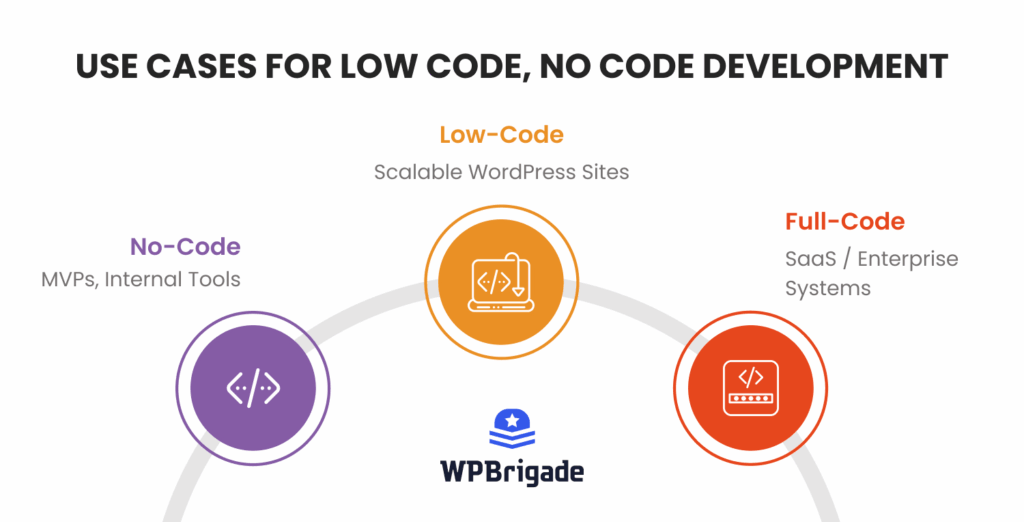
Understanding how to choose low code vs custom code requires looking at your long-term roadmap. The industry has settled on three distinct use cases:
- No-Code is Best for MVPs and Internal Tools: If you need a functional prototype to test a market hypothesis or a simple dashboard to track internal KPIs, no-code is the undisputed winner. It enables disposable development, allowing you to pivot or scrap a tool without losing capital.
- Low-Code is Best for Scalable WordPress Sites and Business Platforms: This is the go-to for 90% of modern businesses. By using low-code website solutions, you get the speed of visual building with the power to scale. For instance, a WordPress-based low-code setup allows you to launch a high-traffic membership portal that can still be customized with unique features as you grow.
- Full-Code is Best for Specialized SaaS and Core Enterprise Systems: Custom code is reserved for scalable and long-term business goals. If you are building a proprietary AI algorithm, a high-frequency trading platform, or a niche SaaS product where performance down to the millisecond is the product itself, full-code remains the gold standard.
Low-Code in the WordPress Ecosystem
WordPress has evolved from its origins as a blogging tool to become the world’s most dominant hybrid low-code platform.
It offers a unique middle ground: the user-friendly nature of a no-code builder combined with the infinite extensibility of an enterprise-grade development framework.
WordPress as a Hybrid Low-Code Platform
The magic of WordPress lies in its modular architecture. It allows businesses to build a site by stacking functional blocks while keeping the underlying code accessible for specialized optimization.
The Core CMS and Gutenberg: The Block Editor (Gutenberg) is no longer just for text; it is a full-site visual engine.
With Phase 3 collaboration features now standard, teams can co-edit layouts in real-time, much like a design tool.
Visual Builders: Tools like Elementor, Bricks, and the native Site Editor provide a high-fidelity drag-and-drop experience. These are the engines behind low-code website solutions that allow for rapid prototyping.
The Power of APIs and Hooks: Unlike closed no-code platforms (like Wix or Squarespace), WordPress provides a robust REST API and Interactivity API. This means that if a low-code tool reaches its limits, a developer can step in and extend it with custom logic.
Plugin Ecosystem: With over 61,000 specialized plugins, you can add complex features, from AI-driven SEO to advanced security, with a single click, epitomizing rapid web development.
Use Cases: Beyond Simple Websites
The versatility of the WordPress low-code stack has opened doors to high-level digital products that previously required six-figure custom builds:
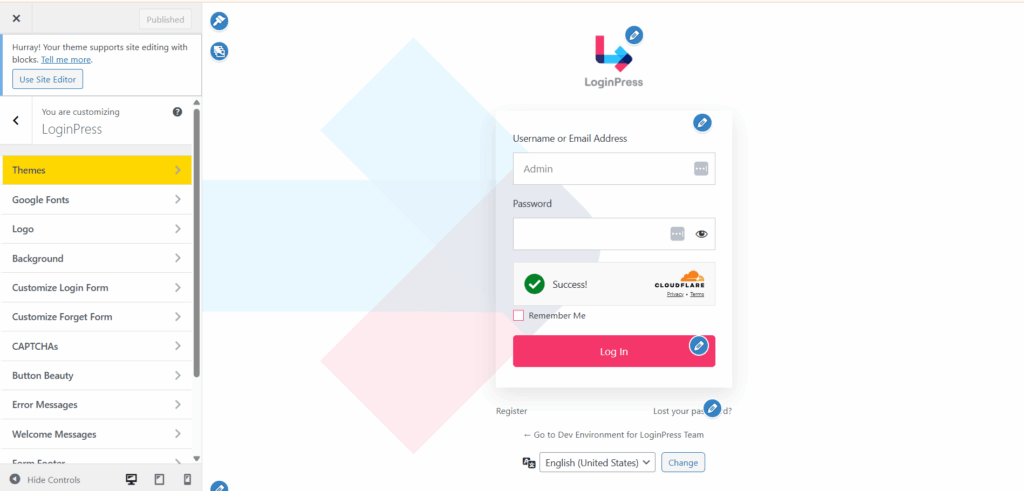
High-Conversion Marketing Sites: Marketing teams can launch landing pages and A/B tests in hours with predefined block patterns, ensuring brand consistency and easy analytics with Analytify.
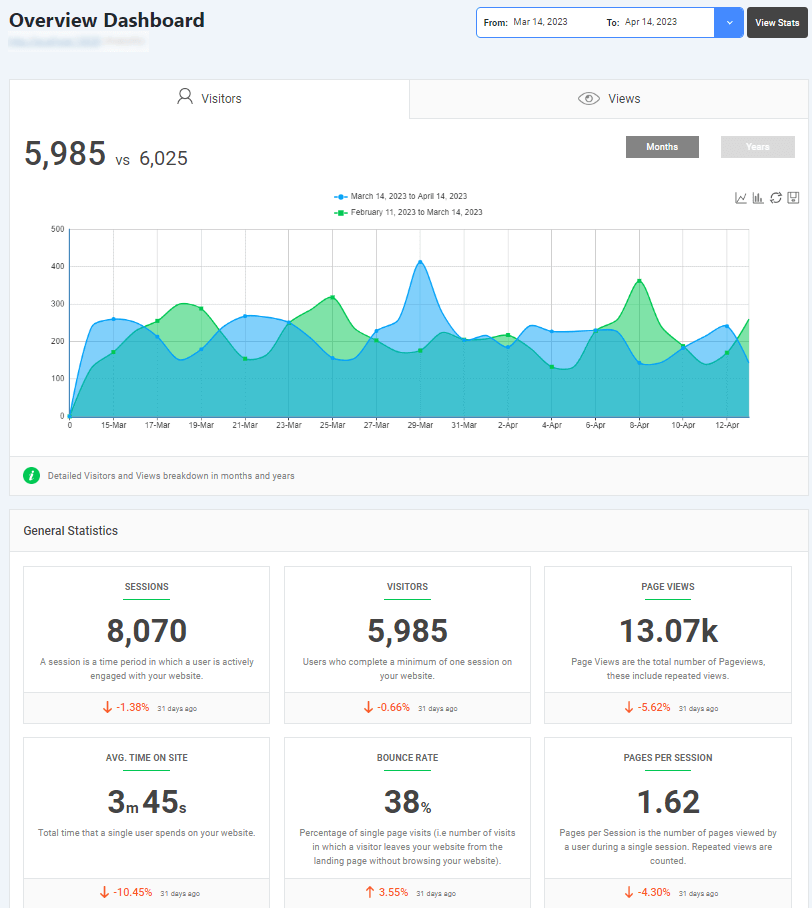
Scalable Membership Portals: Using plugins like LoginPress, businesses can visually build complex gated communities and subscription models.
Real-Time Dashboards: By connecting WordPress to external data sources via low-code connectors, businesses are creating internal performance trackers and client portals.
Automation Workflows: WPBrigade transforms your website into a central intelligence hub. Effortlessly trigger CRM updates and email workflows based on real-time user behavior.
From No-Code Setup to Scalable Systems
Although the rapid development enabled by low code no code (LCNC) platforms is transformative, these solutions are not an all-in-one remedy.
At WPBrigade, we have identified a recurring pattern in the evolution of successful digital projects and the common points at which they encounter obstacles.
Recurring Challenge: The No-Code Wall
Most contemporary businesses initiate their development using exclusively no-code tools.
The primary advantages are clear: reduced overhead and rapid deployment.
For example, a landing page or a basic internal tracker can be launched within a single afternoon.
However, as a project gains traction, the initial simplicity that facilitated quick progress often becomes a limitation later on.
We refer to this phenomenon as the No-Code Wall. It typically arises under the following circumstances:
Feature Rigidity: Business logic evolves, but the tool’s template remains static.
Integration Friction: Synchronizing data between a legacy customer relationship management (CRM) system and a new frontend is hindered when drag-and-drop connectors lack essential security protocols.
Performance Decay: As a database grows from 100 to 100,000 entries, the standardized architecture of many no-code platforms often leads to performance degradation, which can negatively impact user retention.
Many businesses respond to this barrier by discontinuing their progress and investing in a complete full-code rebuild.
This approach is both costly and time-consuming, frequently resulting in a loss of momentum.
The Hybrid Model: Integrating Low-Code Foundations with Structured Development
At WPBrigade, we advocate for a more sustainable path: the Hybrid Model.
The reality is that visual tools are excellent for construction, but they still require a solid architectural blueprint. This is the core philosophy behind the WPBrigade approach.
Rather than viewing low-code and custom development as opposing forces, we treat them as a spectrum. The goal isn’t just to build fast, it’s to build with future-proof intent.
When a project moves beyond the MVP stage, it requires guardrails to prevent performance lag and security vulnerabilities.
WPBrigade positions itself as the technical steward in this process, ensuring that the speed of rapid web development doesn’t compromise the system’s long-term integrity.
- Architectural Guardrails: Structured environments are established to enable marketing teams to use visual builders autonomously, while ensuring that the core database and server logic remain optimized and secure.
- The Escape Hatch Principle: Utilizing WordPress as the foundation ensures that organizations are not restricted by proprietary limitations. When business requirements exceed the capabilities of available plugins or builders, custom code is developed to address these needs effectively.
- Governance as a Service: Centralized systems are implemented to help organizations mitigate Shadow IT by monitoring low-code website solutions for compliance and performance.
Scaling with Precision
Building for the future means selecting a stack that balances “right now” speed with “what’s next” extensibility. At WPBrigade, we don’t just suggest tools; we implement proven solutions that bridge the gap between simple no-code setups and high-performance enterprise systems.
- LoginPress: Securing the Gateway
Identity management is often an afterthought in DIY projects, leading to massive security holes.
We use LoginPress to turn a standard WordPress login into a fortified, fully branded entry point.
It handles everything from brute-force protection to custom session redirects without bloating your codebase.
- Analytify: Hard Data, Zero Guesswork
Scaling requires knowing exactly what your users are doing. Instead of wrestling with complex GA4 tags and external dashboards, we add Analytify directly into your site’s main dashboard.
It translates raw data into clear, actionable insights right in your WordPress admin panel, so you can make growth decisions based on facts, not hunches.
The WPBrigade Standard: Low-code-only reaches its full potential only when it’s backed by technical oversight. This ensures that while you’re moving fast today, your site remains secure, performant, and ready to scale tomorrow.
Ultimately, the future of your digital project shouldn’t be limited by the tools you choose. It’s about having a technical partner who ensures your technology stack evolves alongside your business.
Limitations of Low-Code/No-Code
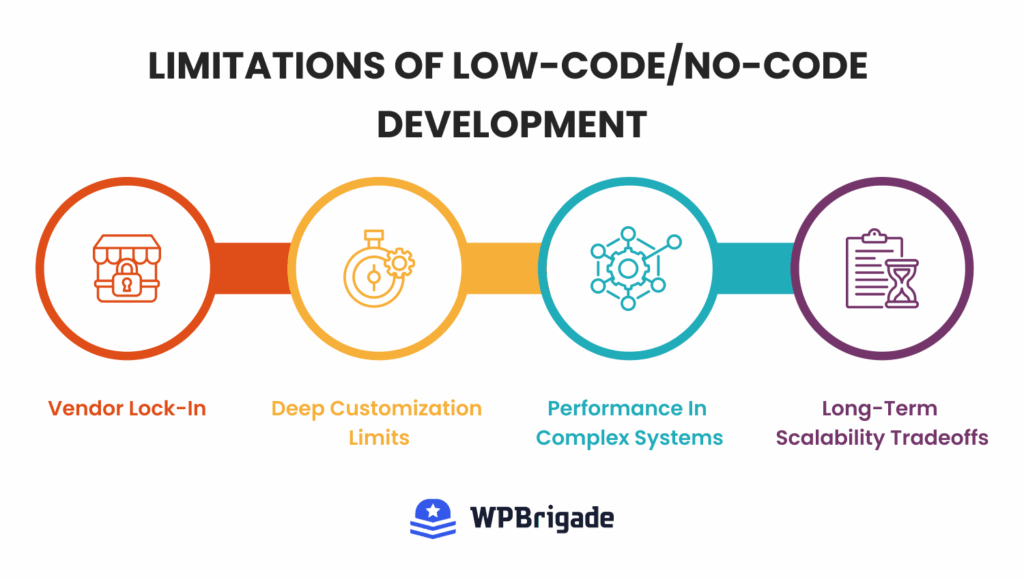
Although the rapid development enabled by low code no code (LCNC) platforms is transformative, these solutions are not an all-in-one remedy.
As enterprises increasingly migrate core systems to visual platforms, several critical limitations have emerged.
Recognizing these constraints is vital for ensuring the long-term viability of such projects. Let’s go through each constraint of low code no code development:
- Vendor Lock-In
A primary risk associated with many SaaS-based low-code web platforms is the absence of code ownership.
Many platforms do not permit users to export or access their source code.
Consequently, if the provider increases prices, alters terms, or ceases operations, organizations risk losing control over their digital assets.
Statistics indicate that 25–30% of no-code projects are rewritten in custom code within two years due to limitations imposed by proprietary platform logic.
Open-source solutions, such as WordPress, offer an advantage by enabling organizations to retain ownership of both the database and the code.
This benefit helps avoid the risks associated with proprietary closed platforms.
2. Performance Bottlenecks in Complex Systems
LCNC tools rely on multiple layers of abstraction, which facilitate ease of use but introduce execution overhead.
Visual builders often generate generic database queries that are not optimized for high-volume data, leading to slower load times as the user base grows.
Many no-code platforms experience difficulties with fine-grained concurrency.
When thousands of users attempt complex actions simultaneously, these systems may experience significant lag or even crash.
3. Long-term Scalability Cost
Because no-code development benefits include empowering non-technical teams, it often leads to Shadow IT, apps built outside the IT department’s oversight.
Unvetted apps may lack proper data encryption, MFA (Multi-Factor Authentication), or GDPR compliance.
According to industry reports from 2026, nearly 50% of cyberattacks in large enterprises originate from unmanaged shadow applications developed using LCNC tools.
4. Customization Barrier and Limits
Eventually, almost every successful project hits a requirement that the visual builder cannot fulfill.
When a project requires highly specialized algorithms or niche legacy integrations, developers often resort to creating workarounds.
Why Low Code No Code is the Future of Digital Projects
With the ongoing shortage of developers, low code no code development has shifted from being a helpful option to a key strategy. Today, it is not just about creating apps.
It is about building a flexible tech stack that can respond quickly to market changes.
Modular software is shaping the future. With API-driven architecture, companies are moving away from rigid, all-in-one systems and toward more flexible setups.
Here, the best tools can be added or replaced easily using low-code platforms. This approach lets projects begin as simple no-code MVPs and add more advanced coding as they grow.
AI-Enhanced Workflows and Autonomy
AI-assisted development is driving this change. We have moved past simple templates to systems that focus on automation.
Today’s platforms include AI agents that do more than help with coding. They recommend full AI-powered workflows and spot performance issues before they become problems.
Combining human creativity with machine speed enables long-term fast web development.
Radical Accessibility
Ultimately, the future of digital projects is defined by accessibility.
When the power to build is no longer locked behind a syntax barrier, innovation becomes democratized.
By lowering the entry floor and raising the ceiling for what’s possible, LCNC ensures that the next generation of digital products is built by those who understand the business problem best, not just those who speak the language of the machine.
FAQs on Low Code No Code Development
Proprietary Algorithms: Unique intellectual property that requires custom mathematical logic.
Millisecond Latency: High-frequency data processing where the abstraction layer of no-code causes unacceptable delays.
Total Data Sovereignty: When strict legal regulations prohibit your data from sitting on a third-party SaaS provider’s server.
Conclusion: Low-Code Website Solutions
In 2026, the question is no longer whether you should use low-code tools, but how effectively you can govern them.
Low code no code development has unlocked unprecedented speed. This agility with expert WordPress development creates truly sustainable digital growth.
By leveraging the efficiency of visual builders while maintaining the escape hatch of custom engineering, you ensure your project launches quickly, is secure by design, and is infinitely scalable.
This is all for this post. For more related posts, check:
- WordPress as a Platform: From CMS to Business Infrastructure
- How Product-Focused WordPress Companies Build Trust With Users
- How to Choose the Right WordPress Plugins Without Hurting Performance
What’s the biggest wall you’ve hit when using no-code tools for your business projects? Let us know in the comments below!
Leave a Reply