
I’d use a page builder for fast, low-budget sites that non-developers need to edit, and custom WordPress development for sites that need top performance, technical SEO, security and room to scale.
The choice affects your site’s speed, rankings and maintenance costs for years.
With search engines now focusing more on technical quality, performance expectations are higher, security is non-negotiable, and UX is judged in milliseconds.
Page builders win on speed to launch, while custom WordPress development wins on long-term value.
Below, I compare quick builds with page builders against custom WordPress development for long-term growth, with use cases for each.
I’m Muhammad Adnan, CEO of WPBrigade. Page builders and custom development don’t compete as much as people assume. Most sites fit clearly into one camp, and the sections below help you see which.
Custom WordPress Development vs Page Builders (TOC)
- What is Custom WordPress Development?
- What are Page Builders?
- Custom WordPress vs Page Builders: Core Differences
- Custom WordPress vs Elementor : A Direct Comparison
- When Should You Choose Custom WordPress Development?
- When Page Builders Are Still a Good Option
- Why WPBrigade Recommends Custom WordPress Development
- Frequently Asked Questions
- Final Thoughts
What is Custom WordPress Development?
Custom WordPress development refers to the creation of WordPress websites specifically tailored to meet the unique needs and objectives of a business.
Every layer of the site is intentionally designed, developed, and optimized for its purpose.
Key components of custom WordPress development include the following:
- Custom themes are developed from the outset to prioritize performance, accessibility, and brand consistency.
- Custom plugins are implemented to provide only the specific functionalities required by the business.
- Templates are tailored to address particular content types, user flows, and conversion objectives.
- Business-specific logic is incorporated to support workflows, integrations, and unique operational requirements.
Unlike pre-made themes combined with page builders, custom WordPress development is engineered around the specific use case.
Custom solutions give complete control over code quality, user experience, and performance.
With a custom build, developers can optimize site performance and UX without any third-party constraints.
As a long-term strategy, it supports scalability, simplifies maintenance, and gives you the flexibility to adapt as business objectives evolve.
What are Page Builders?
Page builders are visual tools that enable users to design and organize WordPress pages through a drag-and-drop interface.
These tools abstract underlying code into editable blocks or widgets, allowing users to create layouts without writing custom PHP, HTML, or CSS.
Common examples of page builders include the following:
- Elementor, a comprehensive visual page builder
- Gutenberg (Block Editor), the native block-based editor for WordPress
- Divi and Beaver Builder are widely used all-in-one theme and builder solutions
Page builders are particularly well-suited for the following use cases:
- Marketing websites and brochure-style sites
- Campaign landing pages and conversion-focused layouts
- Teams composed of non-technical content editors
By offering intuitive drag-and-drop editing and enabling faster initial setup and deployment, page builders allow small businesses to visually manage layout and design without relying on development resources.
Custom WordPress vs Page Builders: Core Differences
Custom WordPress and page builders differ most in performance, SEO control, scalability, editing experience, cost and security. The table below compares them.
Page Builder vs Custom WordPress at a Glance
| Feature | Page Builders | Custom WordPress Development |
| Development Approach | Visual / Drag-and-Drop | Ground-up architectural planning. |
| Code Ownership | Proprietary to the builder ecosystem. | Full ownership of the custom codebase |
| Plugin Dependency | Excessive CSS/JS; difficult to optimize. | Lean code; zero “bloatware”. |
| Scalability | Performance drops as sites grow. | Designed for long-term extensibility |
Performance & Core Web Vitals (Why Custom Wins)
Custom WordPress sites are usually faster, because they load only the code the site needs. Speed directly affects SEO, user experience and conversion rates.
Core Web Vitals have become baseline requirements rather than optional enhancements.
Page builders: These often load additional CSS and JavaScript globally, even when features aren’t used. This increases page weight and affects load times.
Custom WordPress: This provides cleaner, semantic markup with optimized, conditional asset loading. This gives you precise control over Core Web Vitals metrics.
Lean code improves page speed and mobile performance, which supports stronger SEO rankings.
SEO and Technical Optimization Capabilities
Custom WordPress gives more technical SEO control than page builders, from clean markup to schema and page speed.
Search engines favor sites with clean code and strong Core Web Vitals, which helps your content get indexed quickly.
A high-performance setup removes code bloat, making your site faster and more mobile-friendly than competitors.
Custom WordPress: Custom WordPress allows direct control over schema implementation, crawlable HTML structure, and indexing logic. Custom development aligns more naturally with long-term SEO strategies that prioritize control and clarity.
Page Builders: They contain deeply nested DOM structures and extra scripts that can dilute performance signals.
Scalability, Flexibility, and Future Growth
Custom WordPress scales better, because a modular architecture lets you add features without slowing the site.
This flexibility helps businesses adapt quickly and handle complex workflows, while avoiding the costly rebuilds that come with vendor lock-in.
Custom development: With custom development, you can implement advanced integrations and API-driven architectures. Custom solutions help keep complex workflows and automations from breaking your site or taking it offline.
Page builder: As sites grow, builder-based setups can introduce vendor lock-in and structural limitations.
Custom WordPress development scales better for:
- SaaS platforms
- Membership and subscription sites
- High-traffic blogs
- Enterprise-grade websites
Editor Experience and Content Management
Page builders give non-developers more visual control, while custom builds give a simpler, locked-down editor that protects the design.
With a well-designed system, marketing teams can publish confidently, using structured data and design tools that keep the brand consistent and the site running smoothly.
Page builders: These make editing easy for non-technical teams, including authors and editors, and support visual, controlled editing.
Custom WordPress: Custom WordPress solutions support structured, scalable content workflows through tailored blocks and editorial controls.
I think the best setup combines developer-level control with an editing experience clients find easy, so both technical and non-technical users get what they need.
Cost, Timeline & ROI Comparison
The financial decision between a builder and a custom project is a trade-off between immediate savings and long-term asset value.
| Factor | Page Builder | Custom WordPress |
|---|---|---|
| Upfront cost | Lower | Higher |
| Time to launch | Days to weeks | Weeks to months |
| Ongoing plugin and license costs | Builder license plus add-ons | Fewer paid add-ons |
| Long-term value | Can need a rebuild as the site grows | Built to scale |
Custom WordPress development services frequently deliver a better ROI by reducing technical debt and rework.
Page builders are better for smaller sites, short-term projects, or tight initial budgets, as their upfront costs are lower than those of custom solutions. Builder-based sites may involve long-term costs such as ongoing plugin licenses.
While page builders offer a lower initial cost and faster turnaround for rapid testing, custom development is a strategic investment that maximizes ROI by reducing recurring plugin fees and eliminating the need for frequent, expensive rebuilds.
Security and Maintenance Considerations
Custom WordPress usually has fewer plugins to update, which reduces security risk and maintenance work.
Custom development creates a secure environment with fewer external dependencies, reducing the risk of third-party issues.
Custom WordPress benefits include:
- Reduced exposure through leaner codebases
- Greater control over security standards
The result is a more stable, secure, and maintainable WordPress platform over time.
Page builders need regular updates and plugin management to stay safe, but custom-built sites offer a more stable setup.
Custom-built sites keep their performance and security through regular, centralized code updates. Page builders are often less secure due to their larger attack surface and frequent reliance on third-party updates.
Custom WordPress vs Elementor: A Direct Comparison
Custom WordPress beats Elementor on speed, code quality and long-term flexibility, while Elementor wins on visual editing and launch speed:
Performance
Elementor lets you build pages quickly, but it adds extra CSS and JavaScript to most pages.
Custom WordPress uses leaner code and loads only what’s needed, so sites load faster and perform better on Core Web Vitals.
SEO
Elementor covers basic on-page SEO, but its structure can make it harder to keep your code clean.
With custom WordPress, you control the HTML, schema, and site setup, which is better for long-term SEO.
Scalability
Elementor is a good fit for small or mid-sized sites. As your site grows in traffic or features, you may notice performance and structure issues.
Custom WordPress is built to handle complex needs and large volumes of visitors as you grow.
Flexibility
Elementor gives you design options within its system. Custom WordPress removes those limits, so you can build features, layouts, and workflows exactly as you want.
Maintenance
Sites built with Elementor need regular updates for plugins, themes, and compatibility. Custom WordPress sites usually have fewer moving parts, so maintenance is more stable and predictable.
Elementor is acceptable for simple marketing websites or short-term campaigns. It works well for projects with tight timelines or limited budgets.
Elementor can become a bottleneck for performance-critical websites or SEO-driven growth strategies. Page builders often struggle when implementing complex functionality or deep integrations.
Why businesses outgrow page builders
As businesses grow, they need more speed, scalability, and control. Many eventually move from page builders like Elementor to custom WordPress to keep up with long-term growth.
When Should You Choose Custom WordPress Development?
This table matches common situations to the better approach.
| Your Situation | Better Choice |
|---|---|
| Landing page or campaign site | Page builder |
| Small budget, fast launch | Page builder |
| Non-technical team edits layouts often | Page builder |
| High-traffic or business-critical site | Custom WordPress |
| Competitive SEO goals | Custom WordPress |
| Custom features or integrations | Custom WordPress |
| Site expected to grow for years | Custom WordPress |
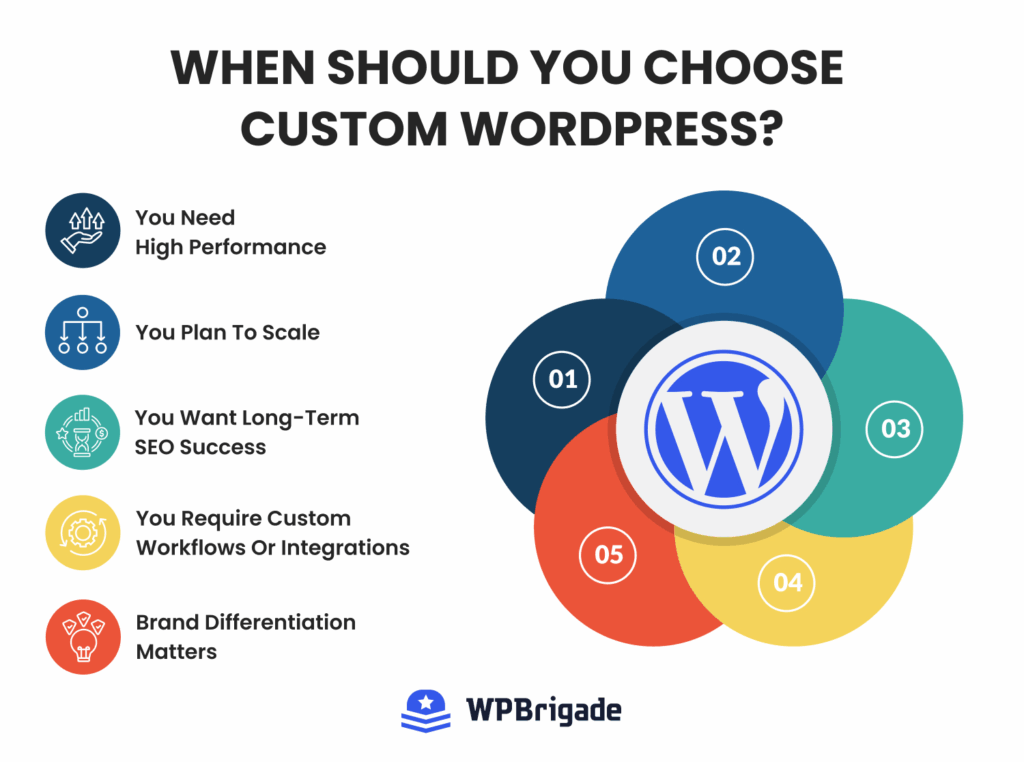
Choose custom WordPress development when your site is business-critical, needs custom features or must rank in competitive searches.
Start by asking these questions against your business goals:
When should I choose custom WordPress development?
When performance, scalability, and long-term flexibility are business priorities, not optional extras.
Is custom WordPress better than page builders?
Custom WordPress is better for complex, high-growth, or performance-driven websites. Page builders are suitable for simpler, short-term needs.
Do I need a custom WordPress website or a page builder?
If your site must scale, rank competitively, or support custom functionality, custom WordPress is the stronger choice.
Here’s when to Choose Custom WordPress:
- You need consistently high performance.
- You plan to scale traffic, features, or content.
- Long-term SEO success is a priority.
- Your site requires custom workflows or third-party integrations.
- Brand differentiation and design control matter.
When Page Builders Are Still a Good Option
Page builders continue to serve a clear purpose within the WordPress ecosystem. For certain use cases, their speed and accessibility make them a practical choice.
They are well-suited for:
- Short-term projects where longevity and scalability are not primary concerns
- MVPs and quick launches that need to validate ideas fast
- Low-budget websites with limited development resources
- Simple marketing pages with minimal functionality
- Internal or temporary sites that don’t require long-term maintenance or optimization
In these scenarios, page builders offer efficiency without the overhead of custom development.
Why WPBrigade Recommends Custom WordPress Development
WPBrigade’s approach to WordPress development is rooted in long-term thinking. When comparing custom WordPress development vs page builders, the question is which works best long term.
Rather than optimizing for the fastest launch, the focus is on building WordPress websites that remain stable, secure, and adaptable as businesses grow.
Custom WordPress development enables WPBrigade to control every technical layer, resulting in faster load times, reduced security risks, and scalable architectures without friction.
These are measurable advantages, not subjective preferences.
Every business operates differently. Custom WordPress solutions let you align site structure and functionality with your business.
The focus is on integrations with actual business workflows rather than forcing processes into pre-built constraints.
Custom development is treated as a long-term asset.
It also reduces technical debt, lowers future maintenance costs, and provides the flexibility to evolve.
This positions your website as a growth platform rather than a short-term deliverable.
Frequently Asked Questions
Final Thoughts
Choose a page builder for a quick, simple site, and custom WordPress development for a fast, secure site built to grow.
Page builders are excellent tools for short-term projects, MVPs, and small-scale marketing pages.
They offer speed and visual flexibility for teams with limited technical resources.
However, custom WordPress development is a strategic platform that is engineered for businesses that refuse to compromise on speed, security, or search engine dominance.
Instead of seeing a website as fixed, custom development turns it into a flexible, scalable asset.
This way, businesses can make clear, long-term decisions and grow without running into the limits or technical debt that come with pre-built frameworks.
For more information about website optimization, check:
- When to Hire a WordPress Development Agency vs Freelancers (2026 Guide)
- WordPress Migration Projects: Risks, Planning, and Best Practices
If you’re evaluating whether your current site architecture is limiting growth, a technical audit can clarify the next steps. Book a call with WPBrigade to audit and optimize your site today!
Leave a Reply