

Claude Fable 5 disappeared from Claude Code mid-project on June 12. It’s back now, but the terms have changed. Claude Fable 5 is back as of July 1, and the Claude Fable 5 updates that matter are a stronger safety classifier and a shorter, capped usage window. Fable 5 is Anthropic’s Mythos-class model, a tier above Opus, built for long, autonomous coding work.
In this post, I cover the Claude Fable 5 timeline, safety rules, limits, and implications for WordPress work. No political backstory, just the operating picture you need this week.
Table of contents
- What Changed When Claude Fable 5 Came Back?
- Why Was Claude Fable 5 Taken Offline in the First Place?
- What’s New in Fable 5’s Safety Classifier, and How Does It Affect Coding Requests?
- What Are the New Usage Limits for Fable 5?
- How Does This Affect Coding Performance for Developers?
- What Does This Mean for WordPress Agencies and Developers?
- Frequently Asked Questions
- Next Steps
Quick TL;DR
- Claude Fable 5 is back as of July 1 with a stronger safety classifier and a shorter usage window.
- The model remains capable for complex coding tasks, but access limitations now apply regarding cybersecurity prompts.
- Agencies should use Fable 5 for long, complex projects and reserve Opus 4.8 for routine debugging to avoid usage caps.
- New usage limits apply: Fable 5 is available for up to 50% of weekly usage until July 7, after which it shifts to metered usage.
- Developers must check their usage dashboard and plan accordingly for tasks based on the model’s capabilities and limits.
What Changed When Claude Fable 5 Came Back?
Fable 5 returned on July 1 with the same underlying model. What changed is a stronger cybersecurity safety classifier and a shorter, capped usage window for subscription plans. Nothing about the model’s coding ability changed. Only access and oversight changed.
Here’s the timeline:
- June 9 — Anthropic launched Fable 5 and Mythos 5 publicly.
- June 12 — The US government imposed export controls, forcing a full suspension.
- June 30 — Commerce lifted the export controls.
- July 1 — Anthropic restored Fable 5 access globally on the Claude Platform, Claude.ai, Claude Code, and Claude Cowork.
- Through July 7 — Fable 5 stays included for up to 50% of weekly usage limits on eligible plans.
Anthropic’s own announcement confirms this sequence and the safeguard work behind it. On June 30, Anthropic said the export controls on Fable 5 and Mythos 5 had been lifted, with Fable 5 available starting July 1 to users globally on the Claude Platform, Claude.ai, Claude Code, and Claude Cowork. For Pro, Max, Team, and select Enterprise plans, Fable 5 includes up to 50% of weekly usage limits through July 7, after which it shifts to usage credits.

Why Was Claude Fable 5 Taken Offline in the First Place?
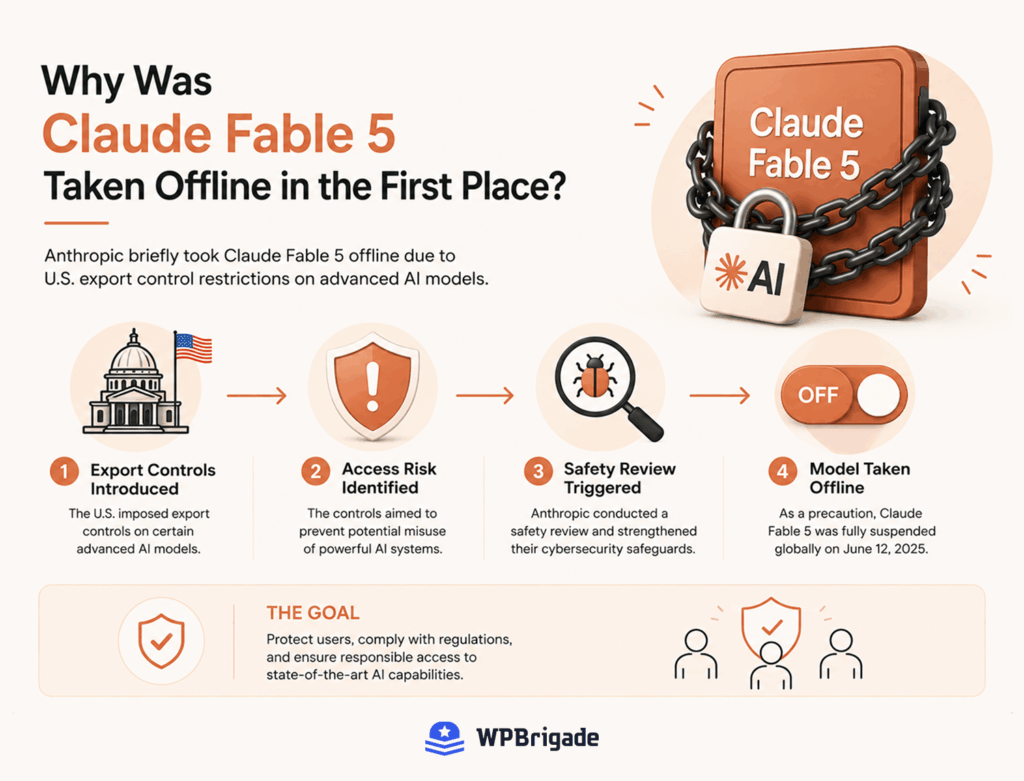
The US Commerce Department issued export controls on June 12. A report claimed users could prompt Fable 5 to identify software vulnerabilities. In one case, it produced exploit code. The order covered all foreign nationals, anywhere, including Anthropic’s own foreign employees.
The order took effect immediately. Because Anthropic had no reliable way to verify nationality in real time, it suspended access to both models for all users.
The trigger wasn’t unique to Fable 5. Anthropic’s testing confirmed that many less capable models, including Claude Opus 4.8, GPT-5.5, and Kimi K2.7, could identify the same vulnerabilities Fable 5 identified in the original report. Controls were lifted on June 30, after Anthropic and the government agreed on an improved classifier.
What’s New in Fable 5’s Safety Classifier, and How Does It Affect Coding Requests?
The new classifier targets cybersecurity-related prompts. It blocks the reported bypass technique in over 99% of cases. Any blocked Fable 5 request reroutes to Opus 4.8, with a notification.
Anthropic has been direct about the tradeoff. The new classifier also comes at the cost of flagging benign requests more often during routine coding and debugging tasks.
Here’s what that means in plain terms. The classifier isn’t removing anything from the model. It reroutes some requests before they reach Fable 5 at all.
For WordPress developers, this matters more than it sounds. A developer writing a login-security check, a vulnerability scanner, or any admin tool touching authentication is more likely to trigger the cybersecurity classifier. That request likely goes to Opus 4.8 instead.
This is a reasonable inference from the classifier’s scope, not an official Anthropic statement about WordPress specifically. Fable 5 hasn’t lost any capability. The routing layer just got more cautious near anything cybersecurity-adjacent.
What Are the New Usage Limits for Fable 5?
Pro, Max, Team, and select Enterprise plans include Fable 5 for up to 50% of weekly usage limits through July 7. After that, it shifts to metered usage credits at standard API rates. Standard Enterprise seats work differently. For standard Enterprise seats, there’s no included Fable 5 allowance. Users can still access it through usage credits, but without enabling credits, they have no access to Fable 5 at all.
Premium Enterprise seats follow the same window as Pro, Max, and Team. For premium Enterprise seats, through July 7, the subscription includes Fable 5 and draws from each member’s seat usage at no additional cost, after which the team can continue by enabling usage credits.
The API was never free. Anthropic prices it separately at $10 per million input tokens and $50 per million output tokens.
| Plan | Included Fable 5 Access | After July 7 |
|---|---|---|
| Pro / Max / Team | Up to 50% of weekly usage limits | Usage credits at standard API rates |
| Enterprise (premium seats) | Same 50% window through July 7 | Usage credits at standard API rates |
| Enterprise (standard seats) | None included | Usage credits must be enabled to access Fable 5 at all |
| API | Not included at any tier | Billed from day one, $10/$50 per million tokens (input/output) |
Terms like this can shift. Check your own Claude usage dashboard for the exact number that applies to your account.
How Does This Affect Coding Performance for Developers?
None of these changes touch Fable 5’s underlying coding ability. It still leads Anthropic’s lineup on SWE-Bench Pro, a benchmark for hard software engineering tasks. Fable 5 scores 80.3% against 69.2% for Opus 4.8, an 11-point gap on long-horizon work (Anthropic’s published benchmarks).
The classifier changes and usage limits are access-layer changes, not a capability downgrade. Fable 5 still meaningfully outperforms Opus 4.8 on long, complex, multi-file coding sessions.
Capability was never the question here. The real question is which tasks are worth spending a capped weekly window on.
What Does This Mean for WordPress Agencies and Developers?
Agencies should route their most complex, long-horizon plugin or theme work to Fable 5, inside the capped window. Keep routine debugging and small fixes on Opus 4.8. That avoids both the usage cap and the classifier’s higher false-positive rate on security-adjacent tasks.
A client migration touching dozens of theme files is a good Fable 5 candidate. Long context, many files, one continuous task, exactly what the model is built for.
A quick login-page security tweak is a different case. That request is now more likely to bounce to Opus 4.8 anyway, so there’s little lost by defaulting it there from the start.
Frequently Asked Questions
Next Steps
WPBrigade evaluates changes like this across every AI coding tool we use on client projects, so our workflows keep working even when the underlying models shift.
- Check your Claude usage dashboard for your current Fable 5 allowance.
- Reserve Fable 5 for long, complex refactors or migrations, not routine debugging.
- Confirm your team has a fallback model (Opus 4.8) configured for when the cap hits or a request reroutes.
Talk to WPBrigade AI experts about your AI-assisted dev workflow.
Further Readings:
Leave a Reply