
To choose a good domain name, keep it short and memorable, pick .com if you can, avoid hyphens and numbers, and make it reflect your brand. Then check social handles, trademarks and the domain’s history before you register. Most people spend five minutes on this decision and live with it for years, so a little planning pays off. Rename your site later, and you lose backlinks, rankings, email trust and the brand recognition you spent years building.
Knowing how to choose a good domain name before you launch saves you from all of it.
Below is a simple way to think it through, then 10 tips for choosing a domain name that help with branding, SEO, and the technical side. You will also see the mistakes that catch most first-time owners, plus the WordPress details that other guides skip. This advice comes from the sites WPBrigade builds and scales every day.
The short answer: pick a name that is short, easy to say, and easy to spell. Grab the .com if you can, and let it stand for your brand, not just a keyword.
Domain Name Guide (Contents):
- Choosing a Domain Name: What to Think About First
- How to Choose a Good Domain Name: 10 Tips That Actually Work
- Tip 1: Keep It Short and Memorable
- Tip 2: Choose .com If You Can
- Tip 3: Avoid Hyphens and Numbers
- Tip 4: Make It Reflect Your Brand, Not Just Your Keywords
- Tip 5: Check Social Media Availability
- Tip 6: Research Trademarks Before You Register
- Tip 7: Think About Long-Term Growth
- Tip 8: Check the Domain’s History
- Tip 9: Consider Registering Multiple Extensions
- Tip 10: Register It Today, Not Tomorrow
- What Domain Name Mistakes Should You Avoid?
- How Does Your Domain Name Affect Your SEO and Branding?
- Best Domain Name for WordPress Sites: How to Choose the Right One
- How Do You Check if a Domain Name Is Available?
- Frequently Asked Questions
- Conclusion: Domain Name Best Practices to Remember
Choosing a Domain Name: What to Think About First
Decide your brand direction, your audience and your site type (business, blog or personal) before you choose a domain name. These three answers shape every decision that follows.
Each site type follows a different naming logic. A personal brand often uses your real name. A business needs a name that signals what it does. A blog needs room to expand if the topic grows.
Growth matters more than people expect. A name that is too narrow can trap you fast. For example, bestpizzanyc.com works locally, but it blocks you the day you want to ship nationally.
Location is the last piece. A local shop and a global startup do not make the same choices, especially around domain extensions. Answer these three questions first:
- Are you building a personal brand, a business, or a blog? Each one points to a different style of name.
- Will this site grow or change? Pick a name wide enough to survive a pivot.
- Is this local or global? This decision drives your domain extension choice later.
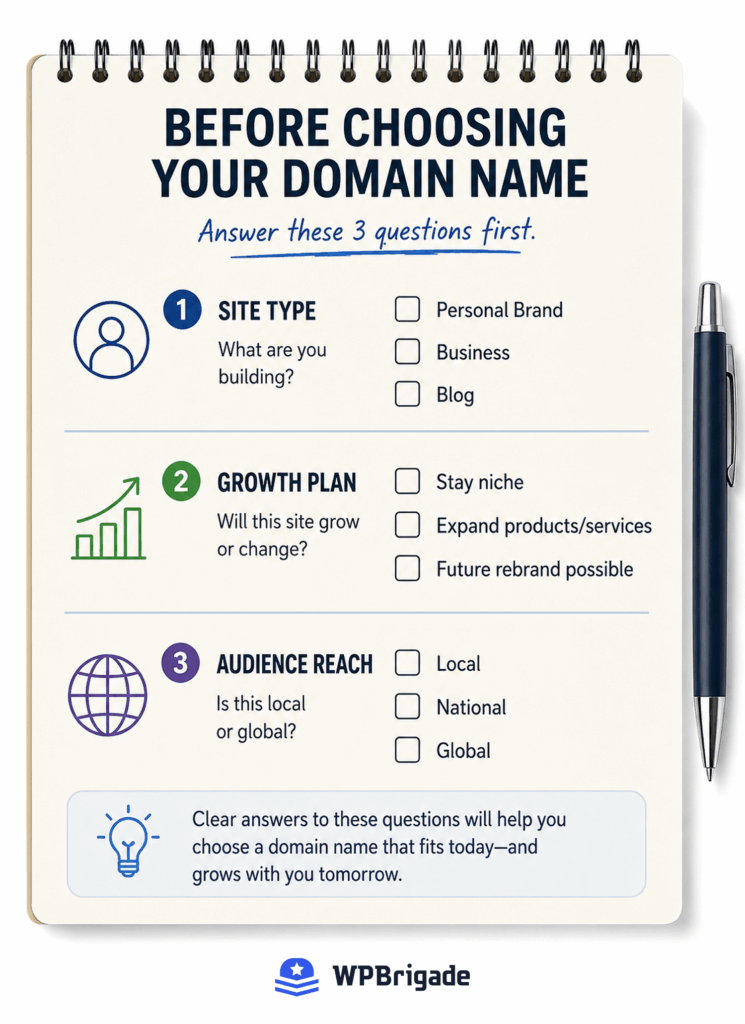
This is the thinking stage. Get it right, and the tips below become easy to follow.
How to Choose a Good Domain Name: 10 Tips That Actually Work
A good domain name is short, easy to spell, free of hyphens and numbers, and available as a .com. These 10 tips for choosing a domain name walk through how to get all four right, in order of importance.
Learning how to choose a good domain name comes down to following each tip below.
Tip 1: Keep It Short and Memorable
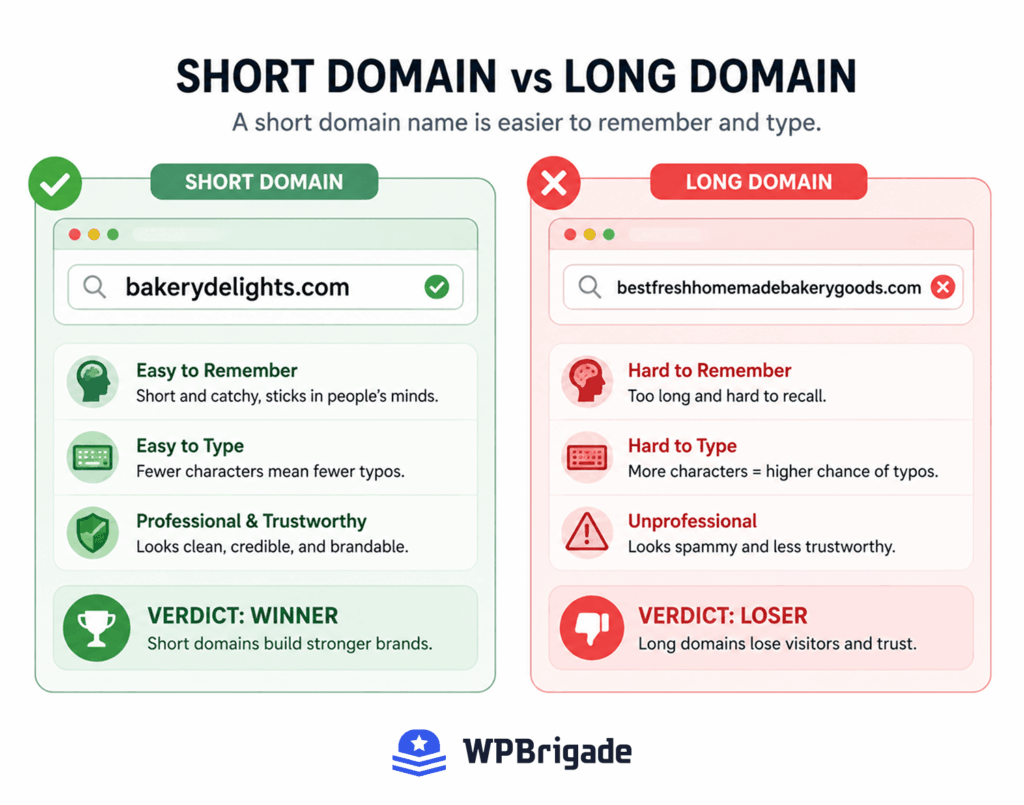
Short domain names are easier to remember, faster to type, and less likely to be mistyped. Aim for 6 to 14 characters when you can.
Long names cause errors and drive visitors away. Every extra word is another chance for someone to get it wrong.
| Domain Example | Verdict | Why |
|---|---|---|
| bakerydelights.com | Acceptable | Short, clear, easy to say |
| bestfreshhomemadebakerygoods.com | Too long | Hard to recall, easy to mistype |
Tip 2: Choose .com If You Can
The .com extension is the most recognized and trusted domain extension worldwide, which makes it the safest default choice for most websites. People assume .com by habit, so they type it automatically.
A quick accuracy note: .com does not give you a direct ranking boost in Google. Google has confirmed that the domain extension does not affect rankings on its own. The real value of .com lies in user trust, direct navigation, and brand recall, not in algorithm preference. You can read Google’s own guidance on this in Google Search Central.
Tip 3: Avoid Hyphens and Numbers
Hyphens and numbers make your domain harder to say aloud and easier to mistype. Say “my-shop-4u.com” out loud and you will hear the problem.
Spoken word-of-mouth breaks down fast with these characters. Keep the name clean and speakable.
Tip 4: Make It Reflect Your Brand, Not Just Your Keywords
A domain name that matches your brand builds trust faster than one stuffed with keywords. This is the core of how to choose a domain name for your business.
Keyword-only names look generic and age badly. A brand name gives you room to mean anything you grow into. Think about a fictional bookstore: brandname.com can sell anything one day, while buybooks.com is boxed in forever.
| Approach | Example | Long-Term Result |
|---|---|---|
| Brand-first | inkwellbooks.com | Flexible, trusted, memorable |
| Keyword-stuffed | cheapbooksonline.com | Generic, limited, dated quickly |
Tip 5: Check Social Media Availability
Before registering your domain, check that the same name is available on the social platforms your business will use. Matching handles across channels is a strong branding signal.
A mismatch confuses customers and weakens recall. Lock in the same name across the board when you can.
Tip 6: Research Trademarks Before You Register
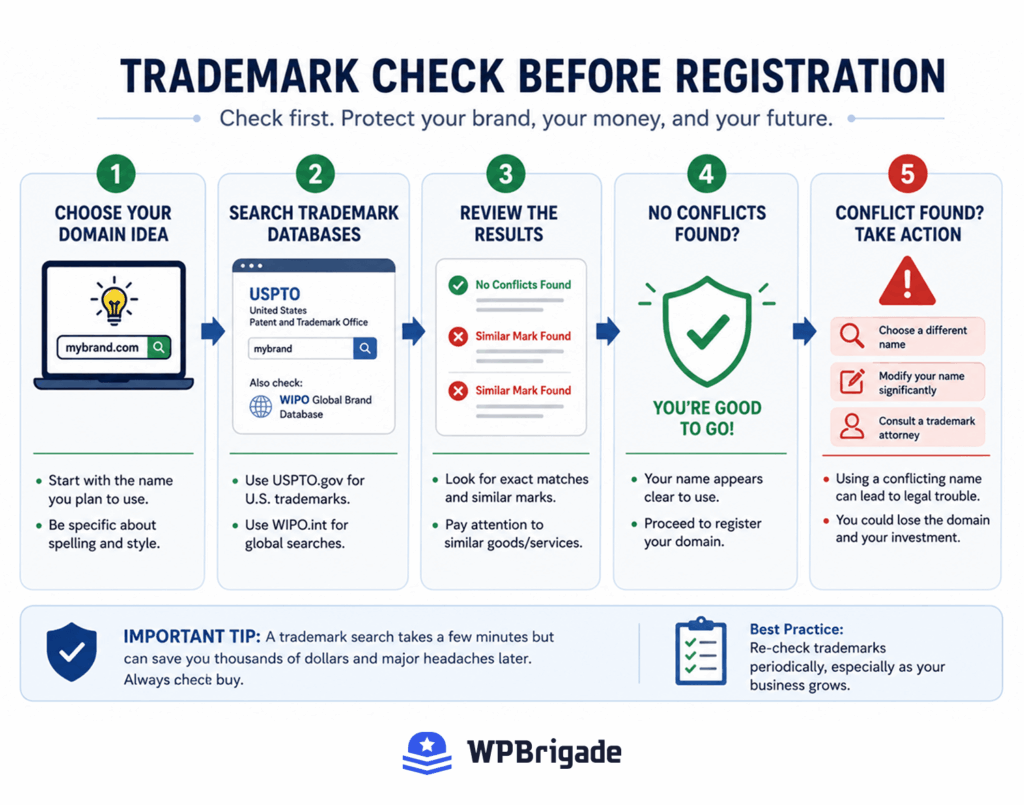
Registering a domain that matches a trademarked brand name can lead to legal disputes and forced transfers. You could lose the domain and the money you spent on it.
Check before you buy, not after. Search USPTO for US trademarks, or WIPO for global ones.
Tip 7: Think About Long-Term Growth
Your domain should still make sense five years from now, even if your business expands or pivots. A name tied to one product or one year will date you.
This matters for blogs too. A narrow choice like myketotips.com can trap you if you later turn it into a full food business. If you are learning how to choose a domain name for a blog, pick a name broad enough to grow with your content.
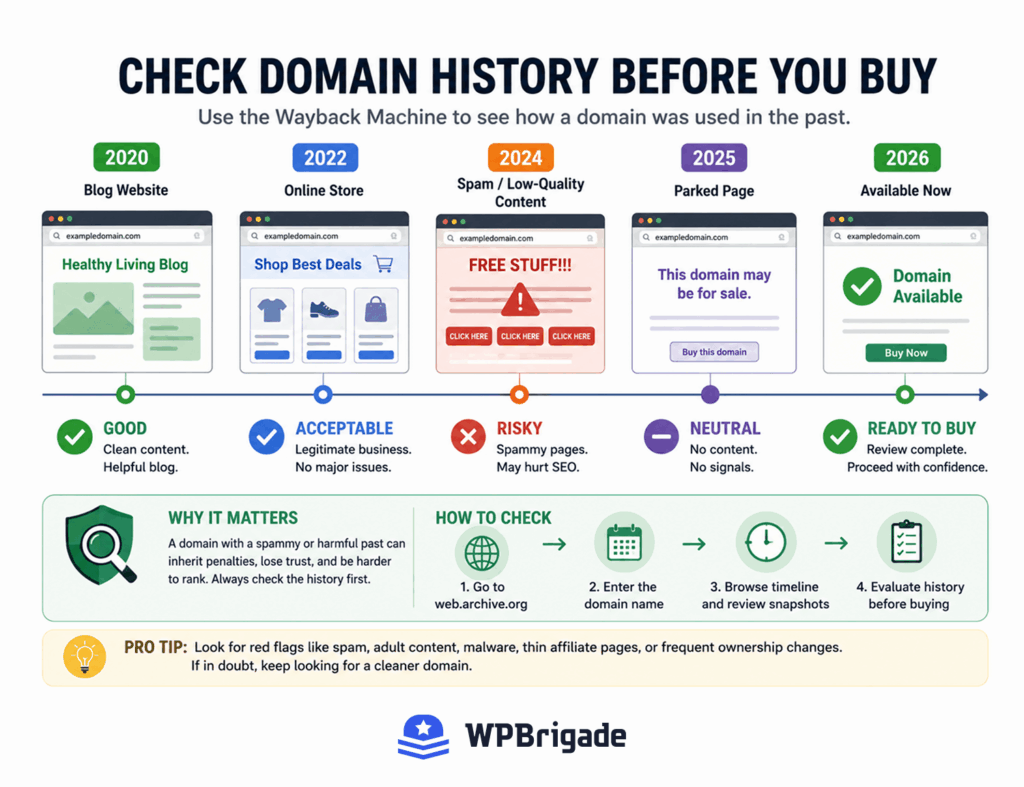
Tip 8: Check the Domain’s History
A domain with a history of spam or Google penalties can hurt your new website before it even launches. Used domains carry baggage you cannot always see.
Check the past before you commit. Use the Wayback Machine and a domain history checker to view what the address hosted before.
Tip 9: Consider Registering Multiple Extensions
Securing your brand name across .com, .net, and .org prevents competitors or bad actors from using similar addresses.
You do not need every extension. Grab the main three if your budget allows, then point them all to your primary site.
Tip 10: Register It Today, Not Tomorrow
Domain names get registered every second, and waiting even a few days can mean losing the name you wanted. Good names disappear quietly.
If you found one you like, lock it in now. Before you do, check the common mistakes below.
What Domain Name Mistakes Should You Avoid?
The most common domain name mistakes are choosing a name that is too long, too similar to an existing brand, or so keyword-heavy that it cannot grow with your business. These errors are easy to make and expensive to fix later.
Knowing the domain name best practices means knowing the traps first. Here are six mistakes and what to do instead:
| Mistake | Why It Hurts | Better Choice |
|---|---|---|
| Using hyphens | mygreat-site.com looks spammy and is hard to say | Pick a single clean word or two joined words |
| Picking a trendy name | Slang and trends date fast and look old in two years | Choose a timeless, plain name |
| Keyword stuffing | bestcheapplumbernyc.com cannot grow or rebrand | Lead with a brand name instead |
| Settling for .net or .biz | A competitor may own the .com and steal your traffic | Rework the name until a .com is free |
| Skipping trademark checks | You risk a forced transfer and legal costs | Search USPTO or WIPO before buying |
| Hard-to-spell names | People cannot find you when they hear your name | Test the name out loud first |
So what does this mean for you? Avoid all six, and you have already beaten most new site owners.
How Does Your Domain Name Affect Your SEO and Branding?
Your domain name affects SEO indirectly through brand trust, user recall, and the authority signals built up over time, not through keyword inclusion in the URL alone. A keyword in your domain does not buy you a ranking.
Google does not directly reward keywords in domain names with ranking boosts. Google Search Central states that exact-match keyword domains hold no special ranking power. You can confirm this in Google Search Central documentation.
What does matter is real and measurable. A memorable domain earns more direct traffic and more click-throughs in search results. Brand mentions across the web act as implied trust signals. Domain authority then builds slowly on that single address over months and years.
This is why your choice is close to permanent. Changing a domain later resets much of that progress. You lose backlinks, you reset accumulated authority, and you carry the overhead of redirecting every old URL. Choose carefully now, and you protect years of future growth.
Best Domain Name for WordPress Sites: How to Choose the Right One
The best domain name for a WordPress website is one that is short, .com, brand-first, and chosen before you build, not after. On WordPress, your domain gets wired into your setup the moment you launch.
Domain choice matters more on WordPress than on most platforms. Your plugins, email accounts, SSL certificate, and hosting environment all attach to that address immediately. Change it later, and you reconfigure all of them.
Three WordPress-specific factors deserve attention:
- Root domain over subdomain. Use yourbrand.com as your main address, not a subdomain, for a business site. Subdomains split authority and look less professional.
- Identity in your tools. Your domain becomes your identity in Google Search Console, GA4, and your analytics from day one. A clean domain keeps that tracking simple.
- Future development fit. When you eventually hire a WordPress development team, a clear professional domain makes the project faster and cheaper to scale.
Domain and hosting connect from day one, so plan both together. A strong domain is the foundation a professional WordPress build sits on.
How to Choose a Domain Name for a Blog
If you’re launching a blog, the same rules apply, but with a personal twist. When thinking about how to choose a domain name for a blog, prioritize a name that reflects your niche or voice rather than a broad keyword. Use your name, a short phrase, or a brandable word that readers will associate with your content. Avoid dates or version numbers that will age poorly. And always lock in the .com first.
How Do You Check if a Domain Name Is Available?
You can check domain name availability instantly using any domain registrar’s search tool. Type your desired name, and the registrar shows whether it is taken and what alternatives exist.
Follow these three steps:
- Type the name into a registrar search bar. Most domain registrars return results in seconds.
- Review the alternatives. If a competitor owns your .com, do not jump to .net. Tweak the name instead.
- Run a WHOIS lookup if it is taken. A WHOIS search shows who owns the domain and whether it is listed for sale.
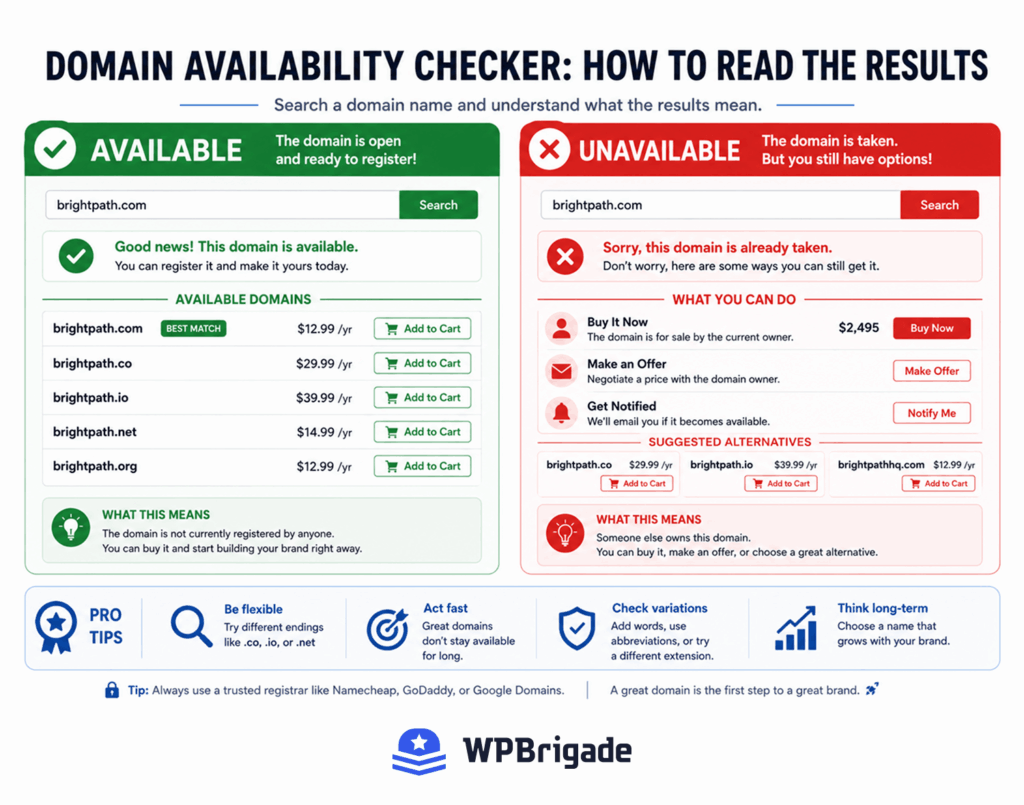
The fix is straightforward: search, compare, and only settle on a name you can own cleanly as a .com.
Frequently Asked Questions
Conclusion: Domain Name Best Practices to Remember
A good domain name is one of the few decisions that affects your website for as long as it exists. Follow these domain name best practices: keep it short, stick with .com, protect your brand, and check its history. They give your branding, SEO, email, and future development the strongest possible foundation from day one.
Here is what to do next:
- Write down 5 to 10 possible domain names based on your brand and what your site will do.
- Use a domain registrar to check the availability of all options. Prioritize the .com version.
- Register your chosen domain today. Do not wait.
Ready to build a professional WordPress site around your domain? WPBrigade designs and develops custom WordPress sites built to grow with your brand. See how we work at wpbrigade.com.
Further Reading:
Leave a Reply